Kayak Pool Training
The best way to learn kayaking is in a swimming pool.
Kayakers should be confident in the water with their head above and below. If you are prone to panic when your face goes under water, think carefully about kayaking as a sport or hobby. This is a very immersive watersport.
You'll enjoy frequent dips into the water while you learn how to capsize your boat, how to right it and then get back inside safely. It's all part of kayaking and is easier than it looks. Low volume play kayaks let you perform all sorts of wild stunts.
Balance
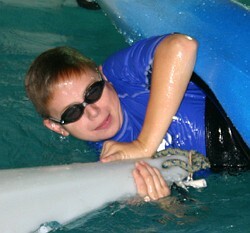
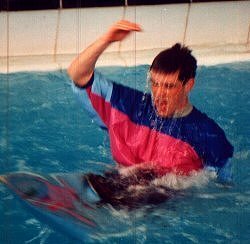
When standing up in a kayak you often fall into the pool but soon learn how to keep your balance. Of course, if you don’t get it quite right, the lesson is enhanced by a dip into the water. This helps you learn to balance a lot better, quite quickly.
It's easier in dry clothes, but you might be more nervous about falling in. Wet clothes are heavier, but give you more confidence because you're no longer worried about getting your clothes wet.
For this reason some teachers get their class to swim several pool lengths in clothes for fun and fitness.
When done at the beginning of a session then everyone paddles in wet clothes.
If you prefer the thrill of getting wet in the heat of the action, do the swim at the end.
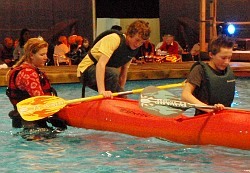
Still in dry clothes and nervous.
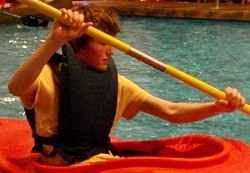
Once wet you're more confident.
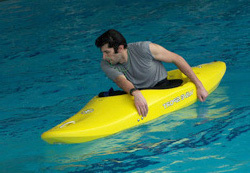
Time to rock and roll.
Helpers and Pool Depth
Helpers keep a safe distance but can quickly assist. The depth of the pool should be shallow enough so that the helpers can stand firmly on the pool bottom in case they need to turn the boat, but deep enough so that the paddler’s head does not get too close to the bottom of the pool.
The helpers should be fully clothed to reduce the risk of injury from the rotating boat. A snorkelling mask lets the helper see clearly under the water and monitor the paddler’s progress. Without a snorkel the helper feels the sensation of holding their breath along with the paddler. As time ticks along the helper has some sense how short the air gets.
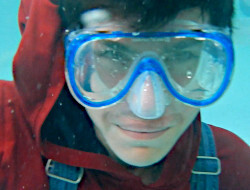
The helper keeps an eye on capsizing paddlers.
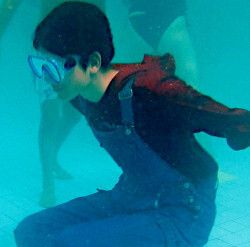
Clothes for Pool Training
Waterproof clothes provide the most realistic pool training. Hoodies soak up a lot of water which makes rolling practice quite challenging. Long pants protect against cuts and bruises in the kayak. A shirt avoids chafing of the spray deck.
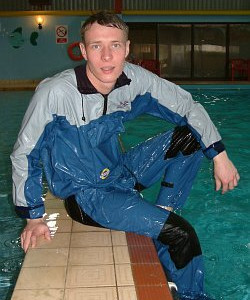

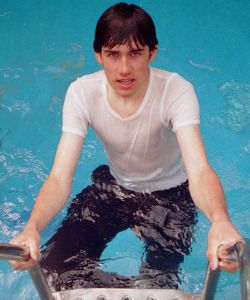
Reader Story: Pool Training
by Karim from Amsterdam, NetherlandsKayak pool training is always huge fun. We learn lots of new skills, like wet exit and entry, rescues, the eskimo roll and how to deal with a flooded boat. Our instructor spends more time in the pool than in his boat, helping us to roll.
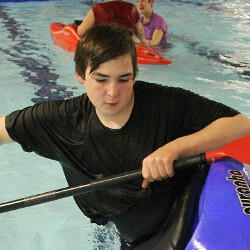
Kayak rolling lessons are fun.
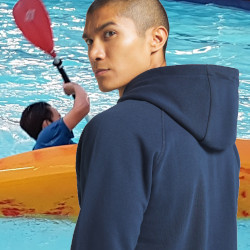
Our instructor often jumps in.
We're told to wear robust clothes for the pool sessions and thus avoid scrapes and bruises when playing with the boats. At first I ignored that advice, but soon painfully realised the wisdom and experience.
Now I always wear a jogging suit in the pool to stay safe.
It feels quite good in the water.
Because I'm the youngest and smallest in the team,
they carefully throw me into the water at the beginning of each session.
They know I enjoy that.
Occasionally we use canoeing helmets which I find a bit hard and uncomfortable unless I wear the hood of my jogging suit underneath.